“Digital Matchmaking” in the Age of AI


One of the most thought-provoking ideas discussed in Tech On Air’s Digital Love and the Relationship Deadlock, featuring journalist and author Şebnem Burcuoğlu, was the concept of an “AI blind date.”
Burcuoğlu described this emerging model of meeting people with a particularly fitting phrase: “digital matchmaking,” or, more literally, a digital version of the traditional Turkish practice of introducing two people believed to be a suitable match.
In traditional matchmaking, families, friends, or members of the same social circle brought two people together because they thought they might be compatible. In digital matchmaking, we may soon hand this intermediary role over to artificial intelligence.
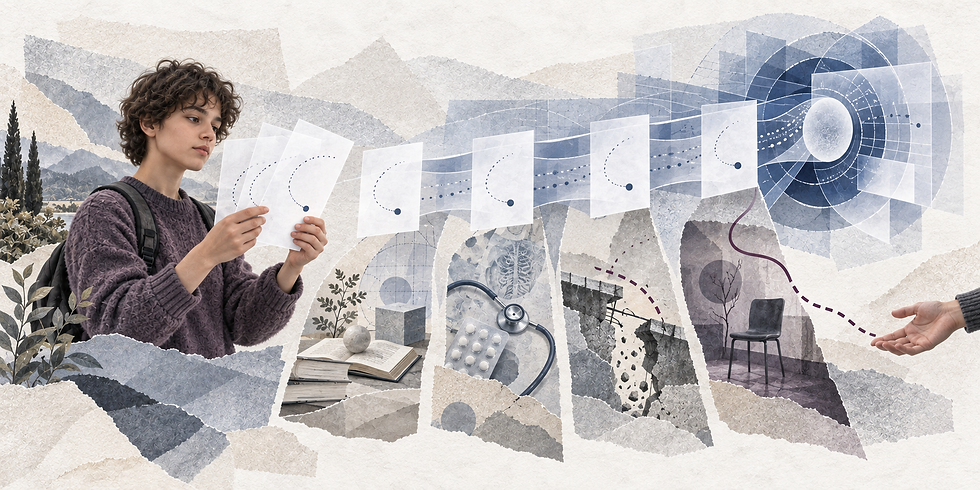
Meeting People Has Become Easier. Building Relationships Has Become Harder.
Today, meeting new people is much easier than it was in the past.
As women and men participate more fully in education, professional life, and social settings, the number of spaces in which they can meet has expanded. Workplaces, universities, travel, events, and mutual friends allow different lives to intersect. Social media and dating apps have extended this possibility even further by giving us access to thousands of people beyond our immediate physical surroundings.
In theory, we have never had so many opportunities to form relationships.
Yet being able to meet someone is not the same as being able to build a relationship with them.
While meeting has become easier, beginning a relationship seems to have become more difficult. The constant availability of another option can make it easier to move on to the next profile instead of taking the time to get to know the person in front of us. People can interact with more potential partners at the same time, yet may form a genuine connection with fewer of them.
Conversations stretch on without leading anywhere. Meetings are postponed. Ghosting becomes ordinary. The possibility that someone more suitable may be waiting behind the next profile can weaken our curiosity about, and patience with, the person already in front of us.
The number of options increases. The number of encounters that develop into meaningful relationships does not necessarily increase with it.
From an Algorithm to a Relationship Intermediary
Until now, we have mostly thought of AI in dating apps as an invisible matching algorithm. It ranked profiles and decided which people we were most likely to see.
We are now entering a different phase.
AI may no longer simply present potential matches. It may get to know us, learn what we expect from a relationship, evaluate possible partners, and even conduct an initial conversation with the other person’s AI representative on our behalf.
In the future described by Bumble founder and CEO Whitney Wolfe Herd, each person could have a kind of “AI dating concierge.” Instead of making us talk to hundreds of people individually, this concierge could communicate with other people’s AI agents and eventually tell us:
“These are the three people in this city you should actually meet.”
This is not yet a fully implemented Bumble feature. For now, it remains a vision for the company’s future. Yet the direction in which dating platforms are moving is becoming increasingly clear.
Facebook Dating’s “Meet Cute” feature moves users away from continuous swiping by automatically suggesting one match each week. Hinge uses AI to recommend topics that could help initiate a conversation based on the other person’s profile. The human still writes the message, but AI accompanies them right up to the threshold of that first exchange.
The central question asked by dating apps is therefore changing.
They used to ask, “Which of these people do you like?”
Now they are beginning to ask, “If I know you well enough, can I decide whom you should meet?”
What Is AI Trying to Solve?
The AI blind-date model promises to reduce the mental and emotional burden that accumulates before a relationship even begins.
It could save people from examining hundreds of profiles, repeatedly starting the same conversations, and spending weeks messaging someone who is unlikely to be compatible. It could move beyond decisions made within seconds based on physical appearance and consider deeper criteria such as values, lifestyle, communication patterns, and relationship intentions.
It might even introduce us to someone outside our established patterns of choice.
In this sense, digital matchmaking recreates a role once performed by family members, friends, and the wider social circle. There is, however, one important difference. The people close to us knew us through shared experiences. AI knows us through the information we provide, our behaviour, and the digital traces from which it constructs a representation of us.
The question is therefore not simply whether AI can find the right person. We must also ask how it defines us and which criteria it uses to decide who is “right.”
Will AI Represent Us or Our Idealised Selves?
AI can build a compatibility model from what we tell it. It cannot fully calculate attraction, body language, the silence that takes shape between two people, or the trust that develops over time.
Nor can our previous preferences easily predict the possibility that another person might change us in an unexpected way. After all, people do not always fall in love with someone who resembles the people they chose before.
There is another question too. The more polished our AI representative becomes, whom will the other person actually meet on the first date? Will they meet us? Or will they meet a more coherent, compatible, and easily explained version of us constructed from our data?
A New Way of Forming Relationships
Perhaps the new model of forming relationships in the age of AI will not remove humans from the process. Perhaps AI will simply reduce the crowd we must navigate before reaching another person.
It may select three people from hundreds of possibilities. It may open the door to the first conversation. It may even arrange the date.
But choosing to remain present during that meeting, making room for another person’s contradictions, and continuing despite uncertainty will still belong to us.
Calculating who is compatible with us is not the same as sensing who we might become beside someone.
Perhaps this is the part of love that will be most difficult to hand over to an algorithm.
Technology can make meeting easier. A relationship must still be built by two people.

Comments